


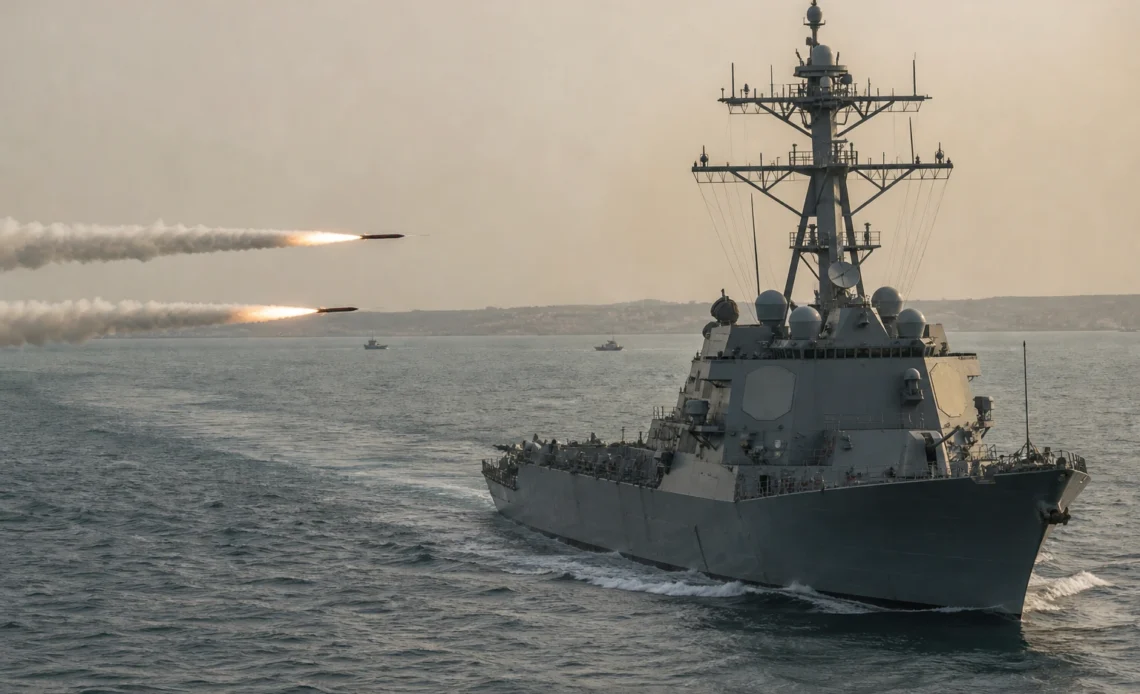
Global tensions in the Middle East have intensified after Iranian state linked media reported a direct missile strike on a U.S. warship near the strategically vital Strait of Hormuz.
But within hours, the United States strongly denied the claim, creating a familiar but dangerous pattern of conflicting narratives during high-stakes geopolitical standoffs.
So what’s really going on?
Iran’s Claim: “We Hit a U.S. Warship”
According to Iran’s Fars News Agency, a semiofficial outlet often linked to the Islamic Revolutionary Guard Corps (IRGC):
- A U.S. warship approached waters near Jask Island, close to the Strait of Hormuz
- Iran issued warnings to the vessel
- The ship allegedly ignored those warnings
- Iran then launched two missiles, which reportedly hit the warship
- The vessel was said to have retreated after impact
What Iran is signaling
This narrative suggests:
- Iran is ready to enforce its maritime red lines militarily
- It wants to project control over critical shipping routes
- It may be aiming to deter further U.S. naval presence
U.S. Response: “This Didn’t Happen”
The U.S. quickly pushed back.
Officials, including sources cited by Axios, stated:
- No U.S. warship was hit
- Claims of a missile strike are false
- U.S. naval operations in the region are continuing as normal
What the U.S. is signaling
- Maintaining operational confidence and control
- Rejecting Iran’s narrative to avoid escalation pressure
- Reassuring allies and global markets
The Reality: Fog of Information War
At this stage, the truth sits in a gray zone.
No independent confirmation
- No verified satellite imagery
- No visual damage evidence
- No neutral third-party confirmation
Competing narratives
- Iran: Demonstrating strength
- U.S.: Denying vulnerability
This is a textbook example of information warfare, where perception can matter as much as reality.
What Might Have Actually Happened?
While there’s no confirmation of a direct hit, several scenarios are plausible:
- Warning encounter: Iranian forces issued warnings, possibly escalating tension
- Missile launch (non-impact): Missiles fired but missed or were intercepted
- Near miss or exercise misinterpreted: High risk maneuvers misreported
- Narrative amplification: Event exaggerated for strategic messaging
Bigger Picture: A Region on Edge
This incident doesn’t exist in isolation.
It comes amid:
- Increased U.S. naval patrols
- Iranian threats to restrict access to the Strait
- Rising geopolitical friction affecting global energy flows
Bottom Line
- Iran claims: A successful missile strike on a U.S. warship
- U.S. says: Completely false
- Reality: Unverified, likely shaped by strategic messaging
The most important takeaway:
This situation highlights how quickly military tension + media narratives can collide especially in one of the world’s most sensitive regions.
